
Michigan Arrest Records and Charges
Michigan arrest records begin with a law-enforcement action. They can identify the subject, arresting agency, arrest date, booking details, and the alleged basis for custody. An arrest alone is not a conviction and does not ensure that the prosecutor will authorize the same offense. Police send reports to the county prosecutor, who reviews the facts and decides whether to decline, authorize, or change charges. Filed charges then enter a District Court record. A felony can later move to Circuit Court after preliminary proceedings and bindover.
The custodian changes with the record. Police or the county sheriff holds incident and booking material. The prosecutor holds charging review and protected work product. District and Circuit clerks hold filed charging documents and the docket. Current jail placement belongs to the county custody system, while the full prosecution file belongs in Michigan criminal court records. Search each source for the question it can actually answer.
Find Michigan Arrest Records
Start in the county of arrest or prosecution. MiCOURT Case Search can show public charge and docket history for participating courts, but it is not a statewide jail roster. The county sheriff or police department is the source for releasable arrest and booking material. The prosecutor may receive a focused FOIA request for existing agency records, subject to investigation, privacy, security, and other exemptions. Use the court clerk for the filed complaint or information.
- Choose the county where the arrest happened or charges were filed through the county directory.
- Search MiCOURT by defendant name or case number, then select the correct District or Circuit Court.
- Open the case and read every charge, statute, amendment, docket entry, and disposition separately.
- Contact the sheriff or police records unit for releasable arrest and booking documents.
- Ask the clerk for a copy of the filed charging document when exact language or certification matters.
Names alone can match more than one person. Use a birth date, middle name, alias, court, or case number when the system permits. MiCOURT is public information rather than the official record. A result may omit documents or nonpublic data, and absence does not prove that the arrest or file never existed.
Michigan Charging Documents
A misdemeanor may start by complaint or citation. A Michigan felony begins in District Court with a complaint and warrant or an appearance. After a preliminary-examination waiver or bindover, the prosecutor files an information in Circuit Court. A grand jury can return an indictment, but ordinary Michigan felony practice commonly uses a complaint followed by an information.
| Complaint | Information | Indictment | |
|---|---|---|---|
| Source | Sworn accusation approved and filed for the District Court case | Prosecutor's felony charging document after waiver or bindover | Grand-jury accusation |
| Michigan use | Misdemeanors and initial felony proceedings | Final felony prosecution in Circuit Court | Available, but less common than complaint and information practice |
| Read for | Initial counts and probable-cause basis | Circuit Court counts after preliminary stages | Counts returned by the grand jury |
Michigan Court Charge Status
Charge status changes throughout a Michigan prosecution. Police may request one offense, the prosecutor may authorize another, and later negotiation or rulings may amend or dismiss a count. One case can end with a conviction on one charge and dismissal or acquittal on others. Read the most recent status and signed order for each count.
| Status | What It Means |
|---|---|
| Requested or reviewed | Law enforcement submitted the matter, but a filed charge or final decision may not yet exist. |
| Authorized or pending | The prosecutor approved a charge that remains unresolved. |
| Amended | The statute, description, or level changed; compare the original and current charge. |
| Dismissed | The court ended that charge, but dismissal is not the same as a set-aside. |
| Acquitted | A judge or jury did not convict on that charge after trial. |
| Guilty and sentenced | A plea or verdict produced a conviction followed by judgment and sentence. |
Michigan Charges Versus Convictions
An arrest and a filed charge both precede judgment. Neither establishes guilt. Michigan arrest records and court charge records can remain public even when the prosecutor declines another count, the court dismisses a charge, or trial ends in acquittal. A conviction requires a guilty plea or verdict and adjudication. Never reduce a multi-count case to a single yes-or-no label.
| Charge | Conviction | |
|---|---|---|
| Stage | Accusation | Verdict or plea |
| Burden of Proof | Probable cause | Beyond reasonable doubt |
| Meaning | Allegation filed for adjudication | Guilty adjudication by plea or verdict |
Michigan Sealed and Set-Aside Records
Michigan uses “set aside” for much expungement relief. A redaction hides protected fields. Sealing restricts a document or case as law or an order directs. Setting aside an eligible conviction makes it nonpublic for most purposes but does not destroy every government record. Relief may be automatic or application-based. Applications go to the court of conviction and can require approved forms, certified conviction material, fingerprints, MSP processing, notice, and a hearing. Eligibility depends on MCL 780.621 et seq.
| Sealed | Expunged | |
|---|---|---|
| Public effect | Access limited by rule or order | Eligible conviction becomes nonpublic for most purposes |
| Government access | May remain for authorized users | Record remains for statutory uses |
| Route | Specific confidentiality authority | Automatic or court-of-conviction set-aside process |
Michigan Charge Codes and Levels
A charge entry can show the statute, offense description, felony or misdemeanor level, offense date, arresting agency, bond, disposition date, and sentence. Michigan uses offense-specific penalty statutes rather than a universal letter-class scheme for all misdemeanors. Felonies are offenses potentially punishable by more than one year and proceed to Circuit Court for final adjudication. Misdemeanors generally remain in District Court. The level therefore identifies both the possible penalty framework and the clerk likely to hold the final file.
A single arrest can yield several charges at different levels. Codes can change through amendment. Compare the charging document, register of actions, and final judgment instead of relying only on the first arrest description.
Michigan Statewide Charge History
MSP ICHAT is the public name-based Michigan criminal-history service. It aggregates reportable submissions from law enforcement, prosecutors, and courts across all 83 counties. MSP says reporting covers felonies and serious misdemeanors punishable by more than 93 days. ICHAT can include public arrests, charges, and dispositions within its scope, but excludes warrants, traffic, juvenile, federal, tribal, out-of-state, suppressed, and local minor-misdemeanor material. Account and payment rules apply unless statutory free access is available.
Search accuracy depends on identifiers such as full name, aliases, birth date, race, and sex. A name match is not identity proof. Fingerprint-based MSP checks, when authorized or required, are the more reliable identity method. If an ICHAT disposition appears wrong, compare it with the sentencing court and use MSP correction procedures. The local clerk remains the source for complaints, informations, orders, and certified case documents.
Michigan Arrest Record Requests
Agency records use a different access path from court filings. A sheriff, police department, or prosecutor can receive a Michigan FOIA request that describes existing records by subject and date range. The agency may withhold investigative, privacy, security, or other exempt material and may charge permitted search, separation, copying, and mailing costs. Ask for electronic delivery and a cost estimate. A statutory response is not always immediate production.
A representative county prosecutor publishes a local prosecutor FOIA route showing that requests are directed to the agency holding that fragment of an arrest matter.
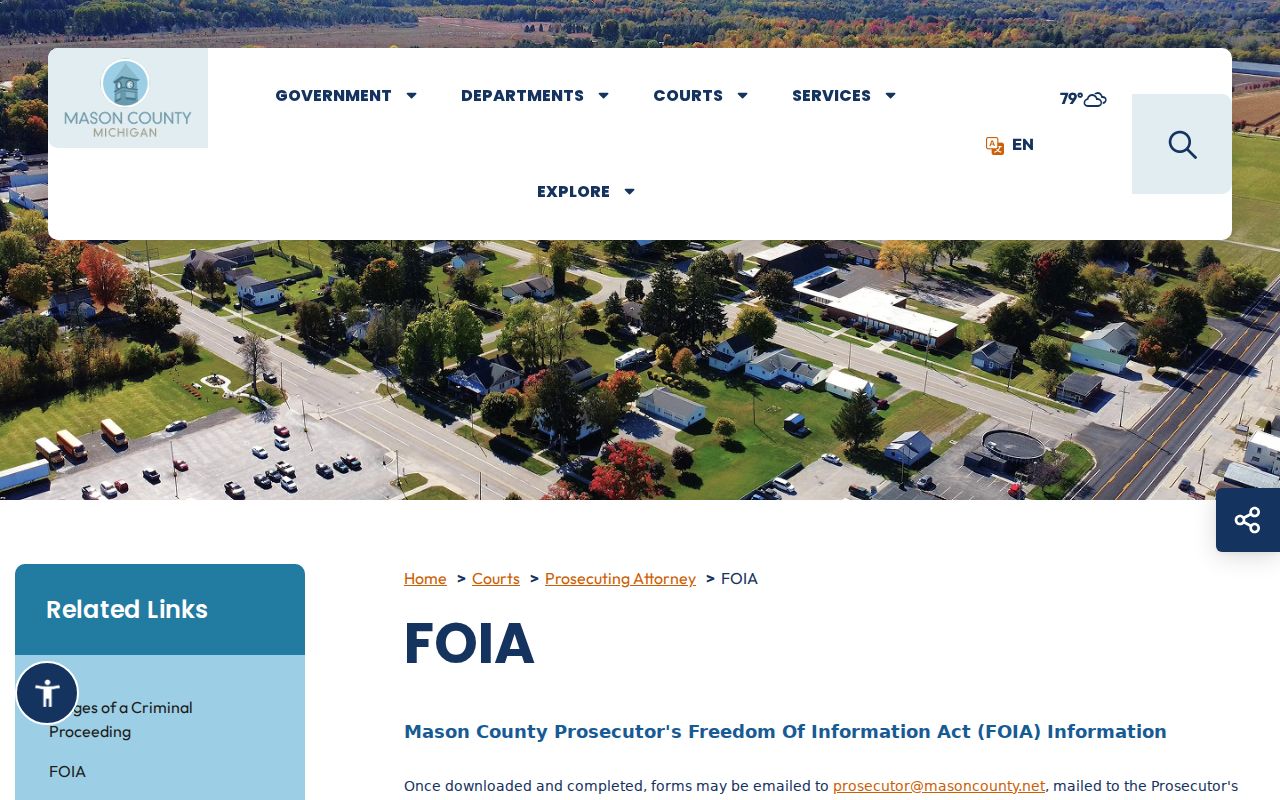
The county example is not statewide. Each Michigan agency has its own coordinator and procedure, while filed charges come from the court clerk.
Important: Employment, housing, or credit screening must follow the Fair Credit Reporting Act, including permissible-purpose and adverse-action requirements.
Restricted Michigan Arrest Records
Juvenile matters, sealed files, set-aside convictions, protected identifiers, and records covered by a court order may not appear in a public search. MCL 712A.28 limits access to many juvenile records. Pending investigative files and prosecutor work product may also be withheld under applicable exemptions. A public portal's silence is not proof that no agency or court record exists.
Michigan Court Rule 8.119 controls public court-file access. Michigan FOIA applies to executive and local agency records. Those routes cannot be swapped. Parties, counsel, authorized agencies, or a person with a court order may have access that the general public lacks. Ask the actual custodian what authority and identification are required.
MCR 8.119(H)-(J) permits inspection of public court files while allowing actual or locally authorized reproduction costs. The clerk can provide the public complaint or information and register of actions. A police or sheriff records unit can answer a separate request for releasable incident and booking documents. When a requester needs both, each custodian should receive a focused request naming the existing record, subject, event date, and desired electronic format.
ICHAT suppression has its own legal framework under MCL 28.243. A public ICHAT result and a county docket can differ because each system has a different scope and update path. Compare apparent errors with the sentencing court, then follow MSP correction procedures. Do not infer that the broader of two results is necessarily the newer or more accurate record.
Note: A dismissal, sealed file, and set-aside conviction have different legal effects, so verify the signed court order before describing a result.