
Active Michigan Warrant Records
Michigan judges issue warrants within cases and investigations under their jurisdiction. District judges issue many criminal and traffic warrants. Circuit Court can issue warrants in its cases, and the state's four remaining Municipal Courts may issue local warrants. A judge evaluates the legal basis, while the court clerk records public docket events and law enforcement receives authority to execute the order. Sheriffs and police may maintain operational warrant information, but public access differs by county.
No confirmed public statewide Michigan warrant index exists. LEIN and e-warrant capabilities are restricted law-enforcement systems and must not be treated as public search tools. MSP ICHAT expressly excludes warrant information. MDOC OTIS may show an absconder status for a person under state supervision, but it is not a warrant database. Use the Michigan county directory to reach each likely issuing court and sheriff.
Public information can lag the court's signed order. A docket may show that a warrant issued, while a sheriff's operational system reflects later service or recall. The reverse can also occur when public data has not posted. Confirm through both the issuing court and law enforcement when present status matters. Ask for the case number, issue date, warrant type, and exact status term used by the office.
Types of Michigan Warrants
The warrant type explains why it was issued and which office can answer questions. It does not show by itself whether the warrant remains active. Confirm status, bond, and the required appearance through the issuing court or sheriff.
- Arrest warrant: authorizes arrest based on a judicial finding of probable cause.
- Bench warrant: commonly follows failure to appear, contempt, or noncompliance with a court order.
- Search warrant: authorizes a defined search of a person, place, or property; it can remain sealed before execution or unsealing.
- Probation or parole violation warrant: concerns an alleged violation of state supervision conditions.
- Civil enforcement warrant: can issue where Michigan law authorizes a coercive court remedy, including some support-enforcement matters.
A bench warrant is not merely another name for every arrest warrant. Its docket context often points to a missed hearing or unfulfilled court order. Search the underlying case as well as the subject's name.
Search Michigan Warrant Records
Build a county list before searching. Include the place of the alleged offense, recent court appearances, residence, arrest, probation or parole supervision, and any support-enforcement case. A warrant can remain in the county that issued it even after the subject moves. Gather the full legal name, aliases, date of birth, and any case or ticket number. These details reduce mistaken identity and help a clerk locate the right docket.
MiCOURT Case Search can reveal public events in participating Michigan courts, including some failure-to-appear or warrant-related entries. It is not a full active-warrant database, and no result is official clearance.
- Open the county directory and select each Michigan county that could have issued the warrant.
- Search the county's official court or sheriff resources. Do not substitute an unofficial people-search site.
- Run the name through the correct District, Circuit, or Municipal Court route and inspect the latest docket entries.
- Call the criminal or traffic clerk using an official number. Ask whether the office confirms public warrant status.
- Contact the sheriff's warrant unit if the county provides one, then confirm bond and appearance instructions with the issuing court.
- Obtain written confirmation after a recall, quash, service, or final disposition.
Michigan Warrant Search Inputs
Michigan has no single public warrant form, so fields differ by local portal and office. The safest inquiry identifies both the subject and the likely case. Never assume that a name-only match belongs to the person sought.
| Field Label | Type | Required | Notes |
|---|---|---|---|
| Full legal name | Text | Usually | Include middle name and aliases when known. |
| Date of birth | Date | Varies | Helps distinguish people with the same name. |
| Case or ticket number | Text | No | Best link to an issuing court docket. |
| County and court | Selection or inquiry | Yes for routing | Check District, Circuit, or Municipal Court as the matter requires. |
| Approximate event date | Date range | No | Can help a clerk locate an older or archived matter. |
What Michigan Warrant Records Show
A public Michigan warrant entry may contain only part of the operational record. Fields depend on the court, warrant type, public-access limits, and whether law enforcement confirms current status. Match the subject, court, and case number before relying on any entry.
| Field | What It Shows |
|---|---|
| Subject and identifiers | Name and limited identifying details used to distinguish the subject. |
| Case or warrant number | Connects the order to the issuing court or agency record. |
| Type and issue date | Identifies arrest, bench, search, supervision, or civil enforcement warrant and when it issued. |
| Underlying matter | May list the charge, missed appearance, violation, or order tied to issuance. |
| Bond or appearance | Can state bond terms, amount, or the court appearance required, if publicly released. |
| Status and agency | May show active, recalled, quashed, served, or closed status and responsible agency. |
Find Michigan Warrants by County
Michigan has 83 counties and local practices vary. Some official sites provide online search, while others require a clerk or sheriff inquiry. Do not assume that each county publishes a roster. The county directory routes to the local court-records site, where official court and law-enforcement contacts can be identified without relying on a third-party aggregator.
The Michigan judiciary's official court search resources help locate courts and public judicial information.
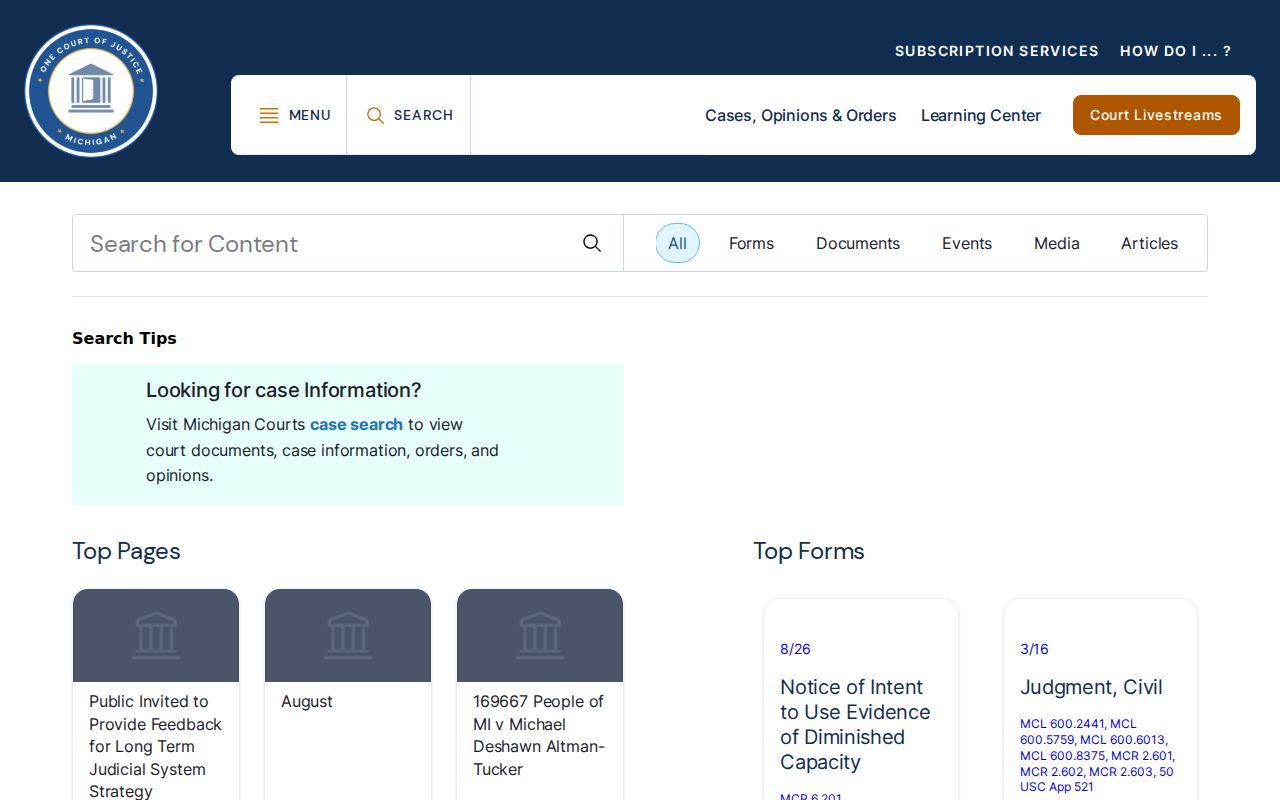
The judicial search resource supports court routing. It does not convert MiCOURT or any court directory into a statewide active-warrant index.
Check more than Circuit Court. Bench warrants often arise in District or Municipal Court, especially after missed misdemeanor or traffic proceedings. A support-enforcement bench warrant may be handled through the court and Friend of the Court. Search every plausible venue.
Michigan's local clerk structure also matters. The District Court Clerk keeps district criminal and traffic dockets. The County Clerk acts as Clerk of the Circuit Court for felony files after bindover. A caller who contacts only the County Clerk can therefore miss a District Court bench warrant. State the nature of the case and ask whether another clerk owns the file.
A releasable sheriff record may be requested under Michigan FOIA, but a records request is built for existing documents rather than instant clearance. Describe the subject, likely date, and record sought. The agency can apply investigation, privacy, security, juvenile, and other exemptions. For a time-sensitive safety or surrender question, use the official phone channel instead of waiting for a FOIA response.
Resolve a Michigan Warrant
First confirm the issuing court, case number, warrant type, charge or violation, and current status. Ask whether the court offers recall or arraignment scheduling and whether a bond is set. If a bond is required, verify the amount, approved form, and payment recipient before sending funds. An attorney can contact the court or prosecutor, explain surrender options, and help arrange an appearance. Appear exactly as directed with identification and any approved surety or payment.
Do not attempt to clear a warrant only by paying an amount shown on an old docket. Payment may not recall the order without judicial action. After compliance, obtain a court entry or written confirmation showing that the warrant was recalled, quashed, served, or otherwise resolved.
Different status words carry different effects. “Active” generally means execution remains authorized. “Recalled” or “quashed” indicates court action withdrawing the warrant, while “served” reflects execution. “Closed” may describe the linked case rather than every enforcement record. Ask the clerk to explain the exact entry and request a copy of the controlling order when proof is needed.
Important: Consult a licensed Michigan attorney before appearing or surrendering when arrest, bond, or immediate custody is possible.
Michigan Tips and Warrant Leads
No statewide Crime Stoppers tip portal was confirmed in the research. Local and regional programs may accept anonymous tips about wanted people within their service areas. Use only a program linked by an official county sheriff or police department. A tip line reports information to law enforcement; it does not confirm a warrant, provide legal advice, or clear an order.
For personal warrant status, contact the issuing court and sheriff instead of a tip program. For an emergency or immediate threat, use the emergency channel specified by local law enforcement.
Restricted Michigan Warrant Records
Sealed search warrants, unexecuted investigative material, juvenile matters, and sensitive records can remain unavailable. Public systems also redact protected identifiers. A court may later unseal a warrant or return, but timing and scope depend on the case and order. A sheriff FOIA request can seek an existing releasable record, yet it is not a real-time safety clearance and cannot compel release of exempt operational data.
Federal warrants are not Michigan county court records. They arise in federal proceedings and use federal courts and agencies. Likewise, a set-aside or sealed state matter may be accessible to authorized government users even though it disappears from public view. Only the issuing authority can confirm what may be released.
Search-warrant affidavits and returns can contain facts that would compromise an investigation or expose protected people. Courts may delay or restrict public access while those concerns remain. Juvenile records follow separate limits under Michigan law. Personal identifiers are also redacted from public copies. A requester may receive a partial record even when the warrant itself is otherwise public.
Note: ICHAT excludes warrants, and an OTIS absconder label is supervision information rather than proof of a particular active warrant.