
Michigan Court System Overview
Michigan has a single high court, not separate civil and criminal courts of last resort. The Michigan Supreme Court supervises the state judiciary and reviews selected appeals. The Michigan Court of Appeals is the intermediate tier. Beneath it, Circuit, District, and Probate Courts carry most trial work. Four Municipal Courts remain for limited local matters. The Court of Claims sits within the Court of Appeals structure for claims against Michigan and its departments.
A case does not move through every row. Most civil and criminal appeals from Circuit Court go to the Court of Appeals, followed by an application to the Supreme Court. District and Municipal Court appeals ordinarily go to Circuit Court first. Probate appeals generally reach the Court of Appeals under the governing route. Original trial files remain with their local custodians when a new appellate docket is created.
Typical appeals path: District or Municipal Court › Circuit Court › Michigan Court of Appeals › Michigan Supreme Court
| Court Level | Court Name | Jurisdiction / Case Types | Number in Michigan |
|---|---|---|---|
| Court of Last Resort | Michigan Supreme Court | Final state review, supervision, rules, and limited original matters | One court; seven justices |
| Intermediate Appellate | Michigan Court of Appeals | Appeals of right and leave applications from Circuit Court and agencies | One court; four districts and 25 judges |
| General Trial | Circuit Court | Felonies after bindover, higher-value civil, family, juvenile, PPO, and local appeals | Judicial circuits covering 83 counties |
| Limited Trial | District Court | Misdemeanors, felony preliminaries, traffic, landlord-tenant, small claims, and civil through $25,000 | Local judicial districts |
| Specialized Trial | Probate Court | Estates, wills, trusts, guardianships, conservatorships, and mental health | County jurisdiction; 10 northern counties form five districts |
| Limited Local | Municipal Court | Local ordinance, traffic, and limited civil or criminal work | Four courts |
| Special State Claims | Court of Claims | Claims against Michigan and its departments | One statewide court structure |
Michigan Supreme Court Authority
Seven justices form the Michigan Supreme Court. It is the state's court of last resort in both civil and criminal matters. Most cases reach it by an application for leave after a Court of Appeals decision, although constitutional and statutory routes can create direct or mandatory review. Its opinions bind the lower Michigan courts. The court also has limited original jurisdiction, rulemaking authority, responsibility for attorney discipline, and general superintending control.
The State Court Administrative Office operates under the Supreme Court. SCAO supports approved forms, statistics, technology standards, statewide administration, and trial-court oversight. This role does not turn the Supreme Court into a central clerk for all trial records. A Circuit, District, or Probate file still belongs to the court where it was filed. Supreme Court docket material belongs to the appellate system.
Note: Michigan has no separate high criminal court, so one Supreme Court sits at the apex for all state matters.
Michigan Court of Appeals
The Michigan Court of Appeals has 25 judges elected in four geographic districts. Panels normally consist of three judges. The court hears appeals of right and applications for leave from Circuit Court, along with certain agency decisions. A published opinion binds lower Michigan courts. An unpublished decision may be persuasive but does not carry the same precedential force. Court of Claims appeals also come to this appellate court.
The district tied to an appeal depends on the governing geographic assignment, but the official appellate resources should control rather than an old copied county list. An appeal creates its own docket containing briefs, orders, and an opinion or disposition. It does not merge all trial pleadings into a new public file. A researcher often needs both the appellate docket and the underlying trial record.
Four-district structure: Michigan maintains one Court of Appeals divided into four geographic districts, not four separate courts of last resort.
Michigan Circuit Court Records
Circuit Court is Michigan's general-jurisdiction trial court. It hears felony cases after District Court bindover, civil actions generally over $25,000, domestic-relations matters, juvenile and child-protective cases through the Family Division, personal protection orders, and appeals from District or Municipal Courts and many local agencies. Judicial circuits can cover one or more counties. Judges may be shared in a multicounty circuit, but files remain associated with the correct county.
The elected County Clerk acts as clerk of Circuit Court. That office keeps civil, felony, domestic, custody, support, Family Division, PPO, and appellate files assigned to Circuit Court. Some record types receive confidentiality protections. The Circuit Court is therefore not merely the next search option when a District Court result is missing. The case must actually have reached or begun at that level.
Michigan Trial Court Comparison
Michigan trial courts divide work by subject, amount, and procedural stage. The offices are also split. A County Clerk does not become custodian of every District Court file merely because both courts serve the same county. The Probate Register performs a separate clerk-like role for Probate Court.
| Feature | Circuit Court | District Court | Probate Court |
|---|---|---|---|
| Civil scope | Generally over $25,000 and equitable relief | Through $25,000; small claims through $7,000 | Trust and estate proceedings |
| Criminal scope | Felony adjudication after bindover | Misdemeanors and felony preliminary stages | Not a criminal trial court |
| Family or protective work | Divorce, custody, juvenile, child protection, PPO | Not the main family court | Guardianship, conservatorship, mental health |
| Records custodian | County Clerk as Circuit Court clerk | District Court clerk | Probate Register |
| Ordinary review | Court of Appeals | Circuit Court | Court of Appeals under governing route |
Michigan Court Appeals Paths
Case movement controls which Michigan file is public and current. A felony begins in District Court with the complaint, warrant, arraignment, bond, probable-cause conference, and preliminary examination or waiver. After bindover, Circuit Court receives the material and handles the information, plea or trial, disposition, and sentence. For cases bound over on or after July 2, 2024, MCR 8.119 makes the duplicate District or Municipal record nonpublic while the transmitted material becomes part of the public Circuit file.
Felony flow: District Court complaint and arraignment › probable-cause conference › preliminary examination or waiver › Circuit Court bindover › plea or trial › sentence › Court of Appeals › Supreme Court leave application
Misdemeanor flow: District or Municipal Court › disposition and sentence › Circuit Court appeal › further appellate review as authorized
General civil flow: District or Circuit filing based on amount and remedy › judgment › correct appellate tier › Supreme Court leave application
Note: An appellate docket does not erase the Michigan trial file or move every underlying document into the appellate system.
Michigan Family and Specialty Courts
The Circuit Court Family Division was created through the 1996 constitutional and statutory reforms and took effect in 1998. It coordinates divorce, custody, juvenile, child-protective, and related family matters. Probate judges may receive concurrent Family Division work. The reform did not merge Circuit, District, and Probate Courts into one identical records office. Custody and divorce files still belong to Circuit Court, while estates remain Probate Court matters.
Michigan also certifies problem-solving courts, including adult and juvenile drug courts, sobriety and DWI/sobriety courts, mental-health courts, veterans treatment courts, and family dependency treatment courts. Business courts operate in qualifying Circuit Courts under MCL 600.8031 and following sections, with opinions indexed for public use. These programs alter supervision and docket events. They do not create one statewide public trial case file.
Michigan District and Municipal Courts
District Court is the court many Michigan residents meet first. It decides misdemeanors punishable by no more than one year, most traffic cases, civil infractions, landlord-tenant matters, civil cases through $25,000, and small claims through $7,000. It also conducts felony arraignments, probable-cause conferences, and preliminary examinations. District judges issue arrest and search warrants and set bond. District Court clerks maintain these files rather than the elected County Clerk.
Only four Municipal Courts remain: Grosse Pointe, Grosse Pointe Farms, Grosse Pointe Park, and Grosse Pointe Shores. Their limited local jurisdiction is comparable in key respects to District Court. They should not be described as a statewide layer of city courts. Elsewhere, Michigan traffic and misdemeanor matters route to District Court.
Federal Courts Serving Michigan
Federal courts are separate from the Michigan court hierarchy. The U.S. District Court for the Eastern District of Michigan principally covers the eastern Lower Peninsula, with locations including Detroit, Ann Arbor, Bay City, Flint, and Port Huron. The U.S. District Court for the Western District of Michigan covers the western Lower Peninsula and Upper Peninsula, with locations including Grand Rapids, Lansing, Kalamazoo, and Marquette. Official district county maps and lists control federal venue.
The Eastern District's official site represents one half of Michigan's federal trial-court structure.
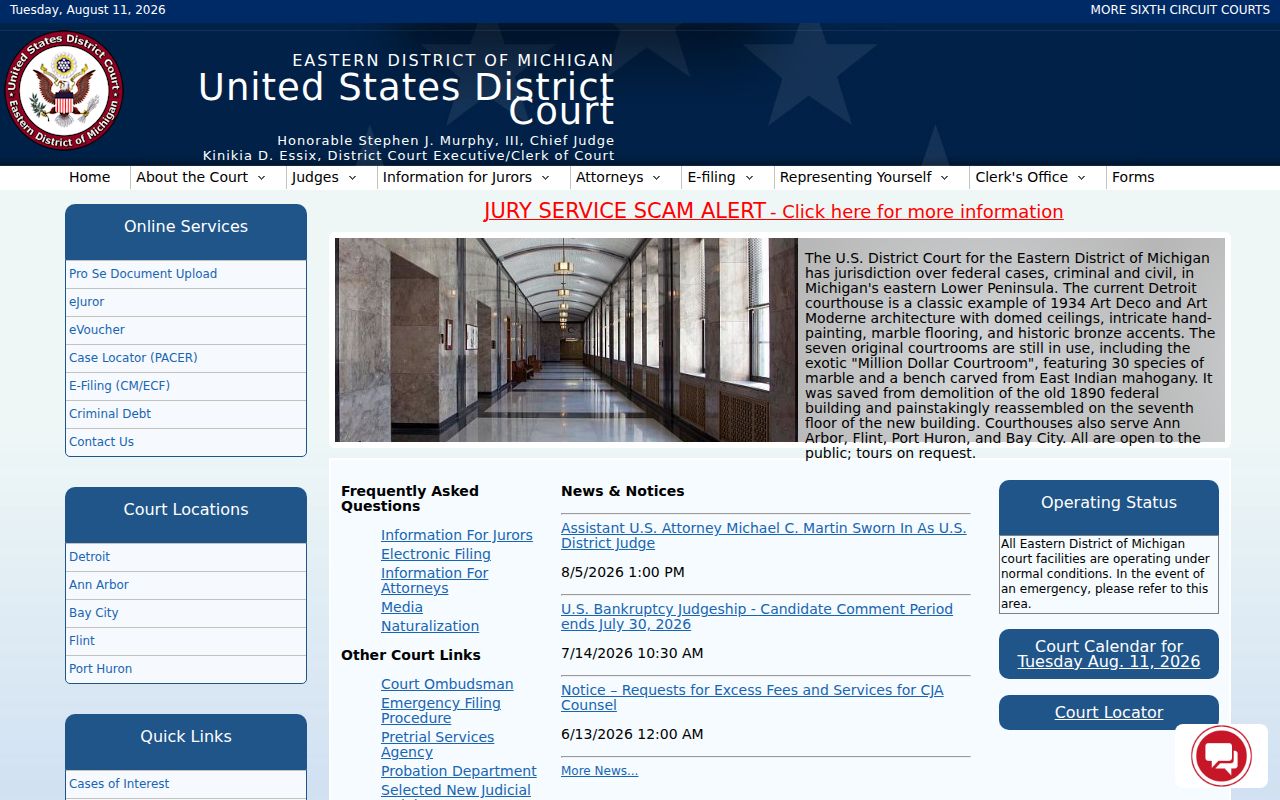
Federal crimes, civil-rights claims, federal questions, diversity cases, habeas petitions, and Social Security review use federal dockets rather than MiCOURT.
The Western District site covers Michigan's other federal trial district and its Lower and Upper Peninsula locations.
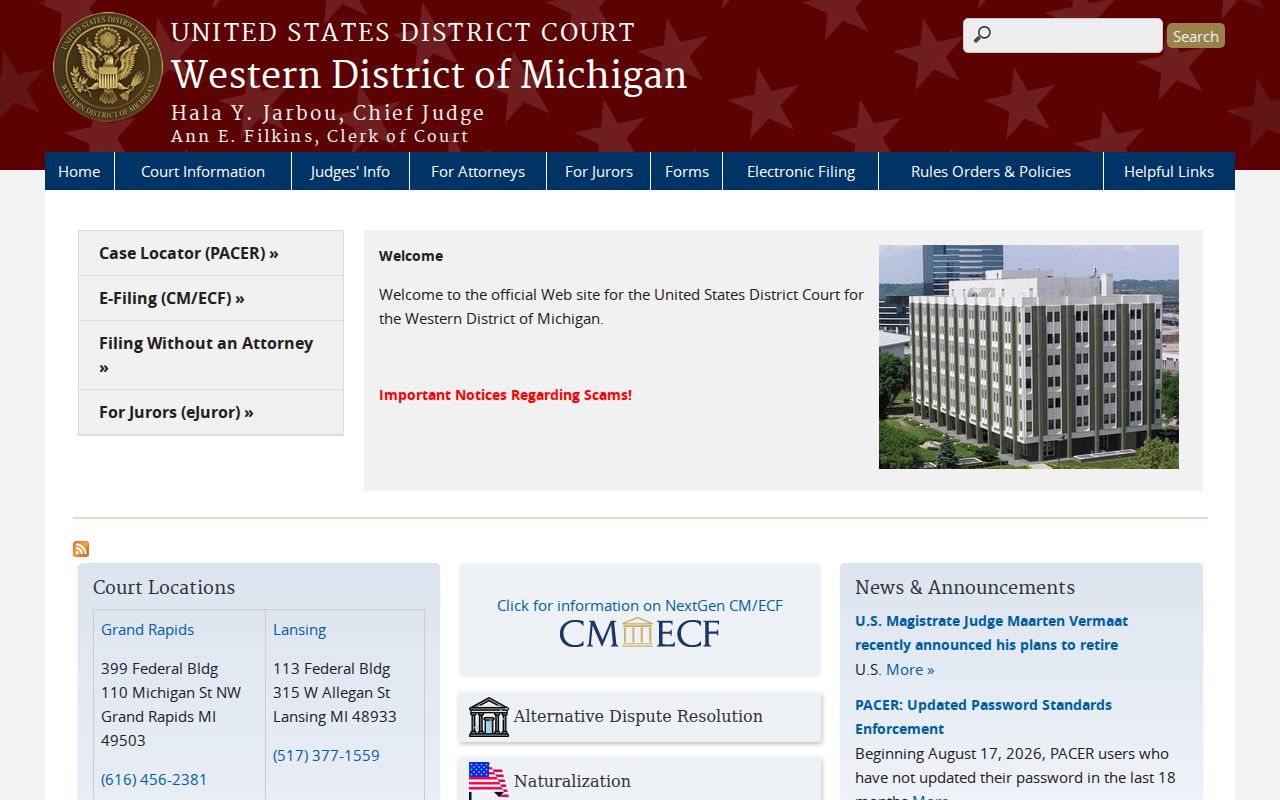
Eastern and Western bankruptcy courts maintain separate dockets. Appeals from both federal districts go to the U.S. Court of Appeals for the Sixth Circuit.
PACER is the federal record system. Registration and current fee rules apply. CM/ECF is filing infrastructure, not a Michigan state portal. Federal prisoners use the Bureau of Prisons locator, not a county roster or Michigan OTIS.
Michigan Court System History
Michigan's Constitution of 1835 created a judiciary before statehood in 1837. Probate courts have earlier territorial roots reaching 1818. The 1963 Constitution established the modern “one court of justice,” placing judicial power in one Supreme Court, one Court of Appeals, and trial courts created by law. The Court of Appeals began work in 1965 and now serves four districts.
District Courts began in 1969 after 1968 legislation replaced justice-of-the-peace and police courts, Circuit Court commissioners, and all but four Municipal Courts. The Court of Claims moved into the Court of Appeals structure in 2013. Michigan later expanded business courts, MiCOURT public searching, MiFILE e-filing, document management, and redaction work. Rules effective April 1, 2022 changed handling of protected personal identifying information in remote documents.
Find Michigan Trial Court Records
Browse the full directory of all 83 Michigan counties to reach the court and records custodian connected to a trial case. Choose Circuit Court for general-jurisdiction and Family Division files, District Court for traffic, misdemeanor, landlord-tenant, small-claims, and felony preliminary files, or Probate Court for estates and protective matters. Confirm the current procedural stage before ordering. Appellate and federal records require their own official systems.