
What Michigan Probate Court Covers
Probate Court is a separate Michigan trial court. It admits wills, appoints personal representatives, oversees decedent estates, and supervises trusts when court action is needed. It also handles guardianships, conservatorships, mental-health proceedings, and matters involving developmentally disabled or protected people. These subjects do not become Circuit Court cases merely because a courthouse houses both courts. The Probate Register performs the clerk-like function and is the correct records custodian.
Every Michigan county has access to probate jurisdiction. Ten northern counties are paired into five probate districts. That arrangement means a court can serve more than one county, but a requester still needs the proper venue and file number. An estate usually begins where the decedent was domiciled. Other venue rules can apply to property or protective proceedings. Use the Michigan county directory to identify the correct Probate Register before ordering records.
Note: Probate judges may receive Family Division assignments, but Probate Court remains a distinct Michigan trial court and records office.
Michigan Probate Terms Defined
Michigan uses terms from the Estates and Protected Individuals Code, often called EPIC. Understanding them helps a reader distinguish an estate file from a guardianship or conservatorship file and request the right document.
- Testator
- The person who made a will.
- Personal representative
- The person appointed to administer the estate, sometimes called an executor in ordinary use.
- Intestate
- Dying without a valid will, so Michigan succession law controls distribution.
- Letters of authority
- The court document proving that the personal representative may act for the estate.
- Guardianship
- A court arrangement focused on personal care and decisions.
- Conservatorship
- A court arrangement focused on property and financial management.
- Inventory
- The filed listing and valuation used to report estate property and calculate an inventory fee.
Search Michigan Probate Records
MiCOURT Case Search provides public history for participating Probate Courts. Choose the correct court, accept the terms, complete the verification, and search by party name or file number. Results can show a register of actions and available case detail. They do not replace the official record. Wills, mental-illness cases, juvenile guardianships, and other excluded matters are not displayed to the general public. No online result does not prove that no file exists.
- Identify the county or probate district where the estate or protective case was filed.
- Choose that Probate Court in MiCOURT and complete the terms and verification steps.
- Search by the party's name or known file number, then apply available filters.
- Open the file number and review the public register of actions.
- Ask the Probate Register for the will, letters, inventory, order, or certified copy needed.
The representative Mason Probate Court route shows the type of court-specific MiCOURT screen a Michigan requester may encounter.
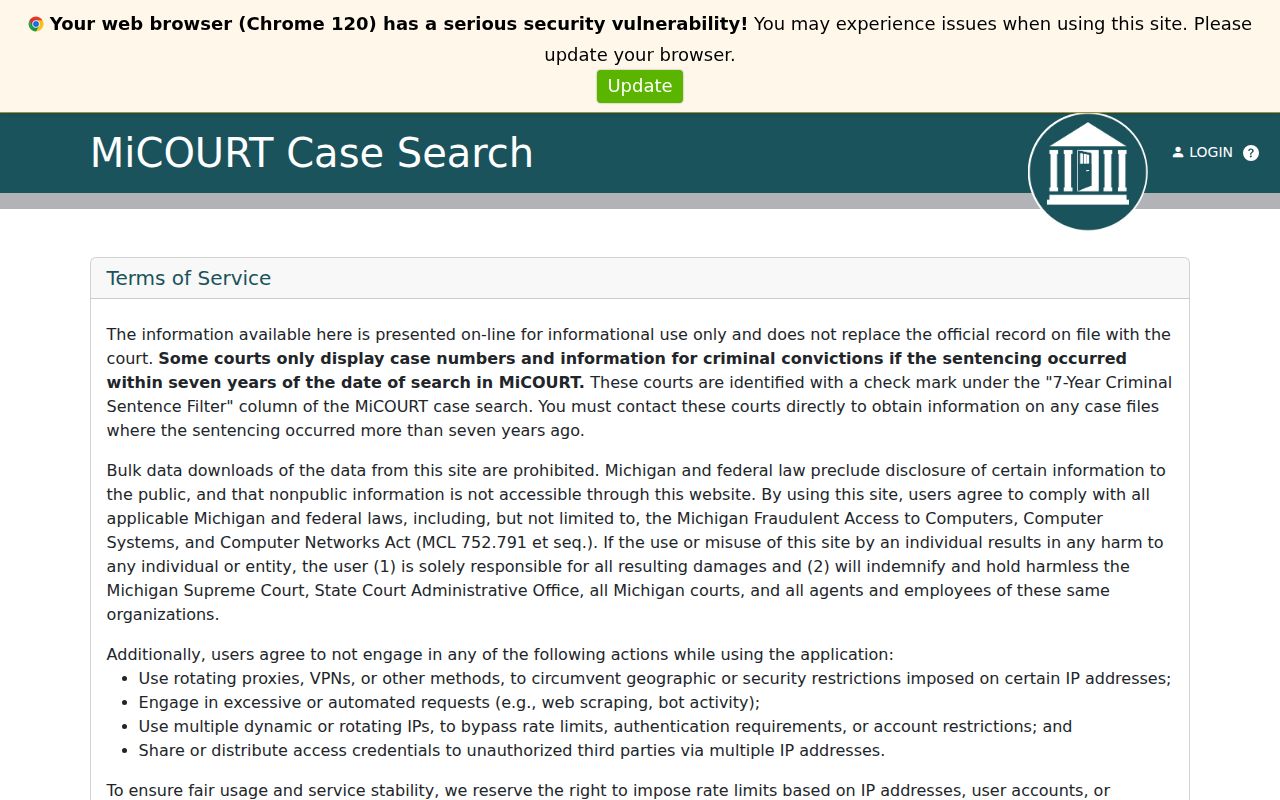
Mason is a local example only. Select the actual Michigan Probate Court connected to the case rather than using its route statewide.
Michigan Probate Court Locations
Michigan probate records remain tied to the county or paired northern district, not one central clerk. A local court can set its own public counter hours, archive-retrieval procedure, copy charge, payment method, and request turnaround. Older records may be on paper or microfilm and need advance retrieval. Contact the Probate Register with the party name, approximate year, case type, and exact document. Ask whether inspection, an uncertified copy, or certification best serves the request.
Find the correct Probate Register: Browse the full directory of all 83 Michigan counties and choose the county connected to the estate or protective case.
Michigan Probate Filing Fees
Michigan probate costs depend on the proceeding. The research supports a proceeding-specific filing charge, an inventory fee tied to estate value, and possible costs for certified letters, publication, a guardian ad litem, copies, postage, or archive work. It does not supply one safe fixed dollar amount for each petition. Current SCAO fee schedules and the Probate Register's quote should control. Inflation-adjusted values and assessments can change.
| Item | Amount |
|---|---|
| Estate application or petition | Proceeding-specific current schedule |
| Inventory fee | Tied to estate value |
| Letters or certification | Quoted by the Probate Register |
| Publication | Separate cost when required |
| Guardian ad litem | Case-dependent cost |
| Copies, retrieval, and postage | Local authorized charge |
What Michigan Probate Records Show
An estate file can contain an application or petition, death certificate, original will, appointment order, letters of authority, notices, proof of publication, inventory, creditor claims, accounts, distribution papers, and closing documents. The register of actions gives a chronological index, but it is not the full file. A guardianship or conservatorship file may show petitions, appointment orders, annual reports or accounts, and review events, subject to access limits. Mental-health files and protected personal data receive stronger controls.
The case record also shows whether the matter proceeded informally, formally, or under supervised administration. Informal probate is an administrative route for an uncontested matter. Formal proceedings seek judicial decisions. Supervised administration retains continuing court authority. These labels help explain why two Michigan estates with similar assets may produce different dockets and document sets.
Note: A public register of actions identifies events but may not include downloadable images of the underlying Michigan probate documents.
Michigan Protective Probate Cases
Guardianship and conservatorship are related but not interchangeable Michigan proceedings. A guardian is appointed to make authorized personal-care decisions for a minor or an incapacitated adult. A conservator manages property and finances for a protected person. One person may need one form of protection, both, or neither. Petitions, appointment orders, acceptance documents, annual reports, inventories, accounts, and review events can appear in the Probate Court file, but the public portion depends on the governing access rule and the person's circumstances.
Mental-health commitment and treatment matters also fall within Michigan Probate Court jurisdiction. They carry privacy limits that do not apply to an ordinary public decedent-estate file. Developmental-disability proceedings can contain medical and deeply personal facts. A public requester should describe the existing document sought rather than ask staff to compile a life history. The Probate Register can confirm whether a case exists, whether the requested item is public, and whether a court order or proof of authority is needed.
Request Michigan Probate Copies
A focused request gives the Probate Register enough information to find the file without guessing. Provide the court and county, case number when known, party or decedent name, approximate filing year, and exact document title. State whether a plain, certified, authenticated, or exemplified copy is needed and give a preferred delivery method. Ask for the maximum cost before work begins. Michigan courts need not create a new record or analysis merely because a requester asks for one.
Public inspection and retrieval are free under MCR 8.119, but actual reproduction can be charged under the court's local administrative order. Certification, archived retrieval, postage, and special handling can raise the total. Older Michigan probate records may take longer because staff must retrieve paper or microfilm. If an online search is incomplete, a direct request is the proper next step rather than assuming the estate or protective case was never filed.
Restricted Michigan Probate Records
MCR 8.119 permits inspection of public court records and bars a charge merely to inspect or retrieve them. It does not make every probate document public. Mental-health matters, protected identifiers, juvenile guardianships, sealed material, and other records restricted by statute or rule remain unavailable to general users. A will deposited for safekeeping before death is also not an ordinary public estate filing.
A redaction hides protected fields while leaving the rest available. A sealed record is inaccessible except as authorized. A party, lawyer, designated agency, or person with a court order may have access that a general requester lacks. Ask the Probate Register what authority and identification are required. Do not treat exclusion from MiCOURT as proof that the court has no file.
Michigan Small Estate Procedures
Michigan EPIC provides simplified tools for qualifying small estates. Assignment of a small estate is addressed in MCL 700.3982, while transfer by affidavit appears in MCL 700.3983. The threshold is adjusted for inflation, so an old figure should not be reused. Current SCAO forms and instructions must be checked against the estate's date and facts.
The official statute page for assignment illustrates why Michigan probate users should rely on current legal text and forms.
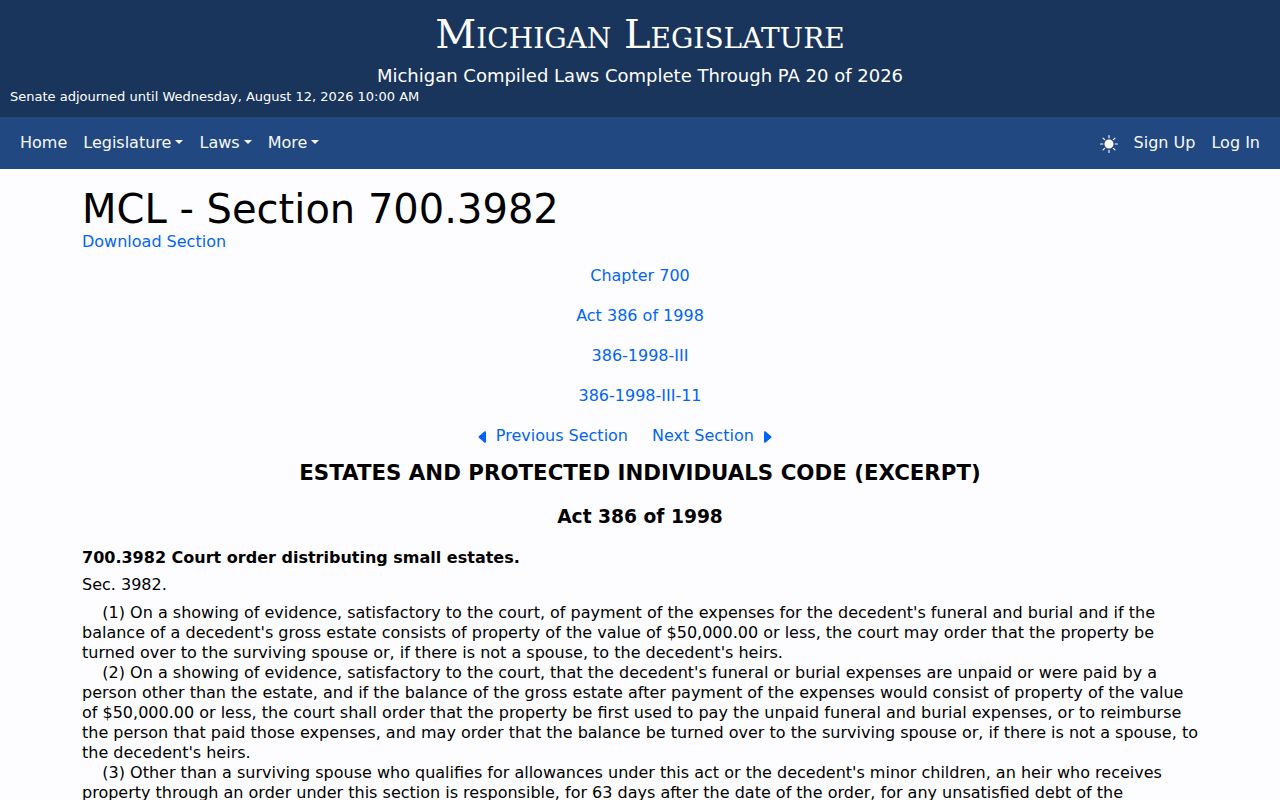
A simplified route still has legal conditions. It does not make a nonqualifying estate exempt from Probate Court.
Michigan Estate Case Sequence
A standard Michigan estate proceeds through a set of linked tasks. First determine domicile and venue, locate the original will, and choose an informal application or formal petition. File current SCAO forms, the death certificate, the will, and the required fee. The court or register appoints a personal representative and issues authority. Interested people and creditors receive notice, with publication where required.
The representative then marshals and inventories assets, pays priority expenses, valid claims, taxes, and administration costs, distributes property under the will or intestacy law, accounts, and closes the estate. A dispute can add hearings and orders. The public file documents this process, but protected identifiers and restricted exhibits should not appear in an unrestricted copy.
Find Michigan Probate Court Records
Browse the full directory of all 83 Michigan counties to reach the Probate Court or district connected to a case. Online searching is a useful first check. The Probate Register remains the endpoint for an official will, letters of authority, old paper or microfilm, a certified order, or a restricted-access question. Supply enough facts to identify an existing file and request a cost quote before ordering.