
Search Michigan Traffic Court Records
Michigan has no single payment site for every ticket. Most traffic and civil-infraction cases are filed in District Court. Four Municipal Courts remain for limited local matters. Start with the citation because it identifies the exact court. MiCOURT Case Search can show public history from participating courts, but the user must choose a county and court. An absent result may mean the court does not participate, the ticket is too new, or the matter is excluded. The clerk remains the source for the official file.
A case or citation number is the cleanest key. A party-name search can work when that number is unknown, but names may return several people. Keep the issue date and court name close at hand. If the issuing court is unclear, use the Michigan county directory to reach the local District Court records office.
- Read the citation and identify the court, response date, and citation or case number.
- Choose that court in MiCOURT, accept the terms, and complete the required verification.
- Search by party name or file number, then open the matching Michigan traffic case.
- Review the charge, scheduled event, disposition, and financial section. Confirm key facts with the clerk.
- Use only a payment or hearing channel approved by the named court.
Michigan Traffic Court Jurisdiction
District Courts decide most Michigan traffic violations, civil infractions, and traffic misdemeanors. They also issue warrants, set bond, and handle criminal steps tied to a misdemeanor case. The four remaining Municipal Courts in Grosse Pointe, Grosse Pointe Farms, Grosse Pointe Park, and Grosse Pointe Shores have limited local authority. Circuit Court is not the routine ticket court. It may receive an appeal or later felony proceeding, while an OWI misdemeanor ordinarily begins and ends in District Court.
Venue follows the issuing court, not the driver’s home county. A driver cited far from home must respond to the court printed on that ticket. Local court staff can confirm whether the matter accepts online, telephone, mail, drop-box, or counter payment. They can also explain scheduling steps, though staff cannot give legal advice.
The Michigan trial-court overview shows how District and Municipal Courts fit into the state structure. Its statewide description helps prevent a ticket from being sent to the Circuit Court clerk by mistake.
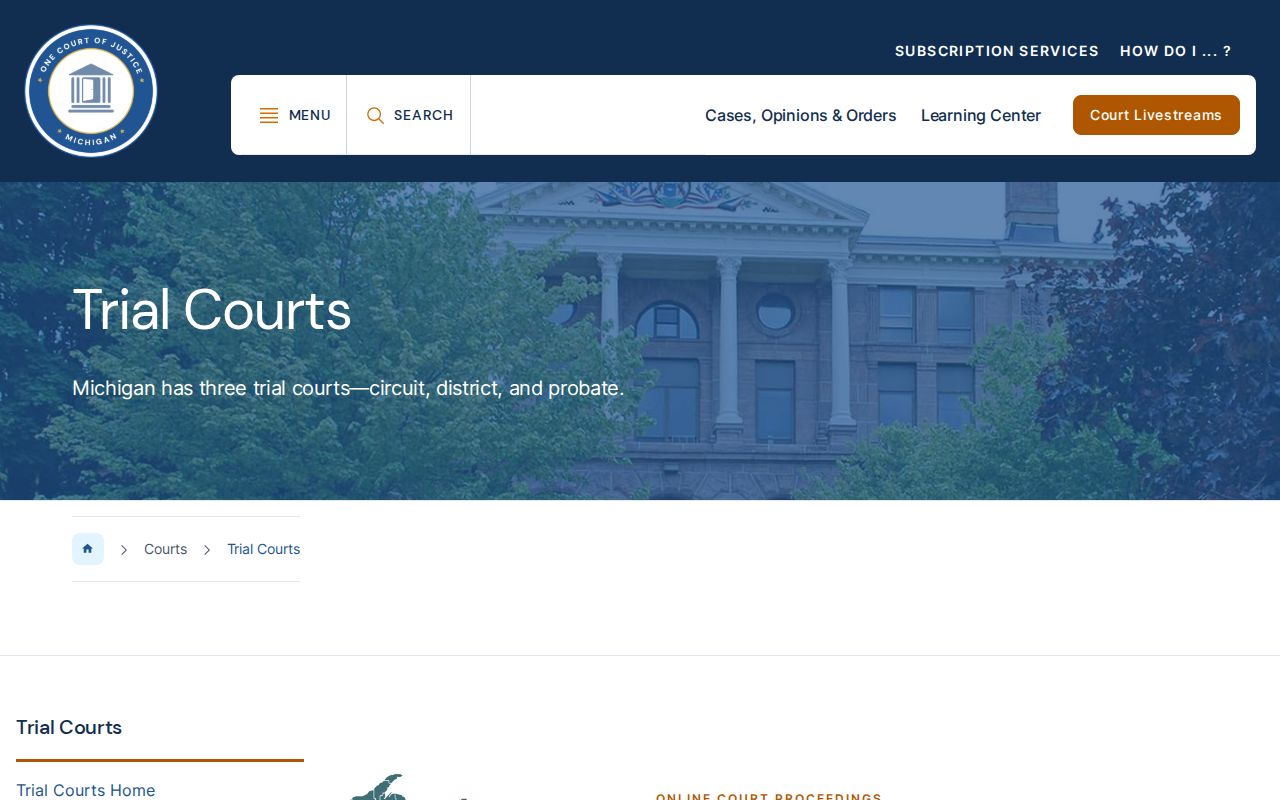
That structure matters because each local traffic court keeps its own docket and sets its accepted response channels.
Note: A local payment vendor is a payment channel, not the custodian of the Michigan traffic court record.
What Michigan Traffic Records Show
A public Michigan court history tracks the case filed from the citation. It may show the offense wording and statute, issue date, court date, plea or responsibility finding, judgment, fines and costs, payments, and failure-to-appear events. The court record can show a dismissal even when no conviction is sent to the state. It may also show a default or warrant event. The driving record is different and should not be used to reconstruct every court step.
| Field | What It Shows |
|---|---|
| Citation or file number | The local identifier used to search and contact the issuing court. |
| Charge and statute | The traffic civil infraction or misdemeanor placed before the court. |
| Issue and event dates | When the ticket began and when a hearing or response is set. |
| Plea or responsibility | Whether the person admitted, denied, or was found responsible or guilty. |
| Disposition | The outcome for that charge, including dismissal, judgment, or conviction. |
| Financial events | Fines, costs, payments, balance, default, and related docket activity. |
Michigan Citation Search Fields
MiCOURT routes traffic searches by court. The representative inspected District Court route required the court context, terms, and human verification before permitting a name or file-number query. Statewide interfaces can vary with the selected court, so a citation number field may appear as a file-number search. The table reflects the documented Michigan path, not a promise that every local portal uses identical labels.
| Field | Type | Required | Use |
|---|---|---|---|
| Court | Route or selector | Yes | Choose the District or Municipal Court named on the ticket. |
| Terms and verification | Confirmation | Yes | Accept terms and complete the human-verification step. |
| Party name | Text | Optional path | Use when the citation or file number is unknown. |
| File number | Text | Optional path | Best direct match when the court number is known. |
| Submit | Button | Yes | Runs the selected Michigan traffic search. |
Note: Public MiCOURT information is informational and does not replace the official traffic file maintained by the issuing court.
Pay or Contest Michigan Tickets
A Michigan driver should act by the response date on the citation. Paying normally works as an admission and can lead to points or insurance effects. Depending on the case and court instructions, a person may admit, admit with explanation where allowed, or deny responsibility and ask for a hearing. An informal or formal hearing may follow. Do not assume an online payment page can schedule a hearing or explain the effect of a plea.
- Confirm the issuing court and read its deadline and response instructions.
- Choose whether to pay, provide an allowed explanation, or deny and request a hearing.
- Send the response through an accepted online, phone, mail, drop-box, or counter channel.
- Attend the informal or formal hearing exactly as the court directs.
- Pay the judgment or use an approved plan, then verify any abstract or clearance with SOS.
A missed response can cause default, added costs, license effects, and warrant action in a criminal misdemeanor. The court must correct its own disposition. If that correction affects a driver record, ask whether the clerk sent a corrected abstract to SOS.
Michigan SOS Driving Records
The Michigan Department of State driving-record service is the statewide source for license status, restrictions, suspensions or revocations, reportable convictions and civil infractions, points, and administrative action. It is not a docket. A court disposition flows to the Department of State by abstract, and the state then updates the driving history. That process can create a lag. Paying the court balance also does not, by itself, end every SOS suspension or reinstatement condition.
A driver can obtain their own certified record through MiLogin and e-Services or at a Secretary of State office. A Record Lookup Unit request costs $15, with $1 for certification. An office copy is certified and costs $16. Requests for another person’s protected data must fit a permissible purpose under the federal Driver Privacy Protection Act. Commercial and government account options do not turn personal driving data into an unrestricted public search.
The official SOS transaction screen illustrates the separate identity and payment process used for a Michigan driving record.
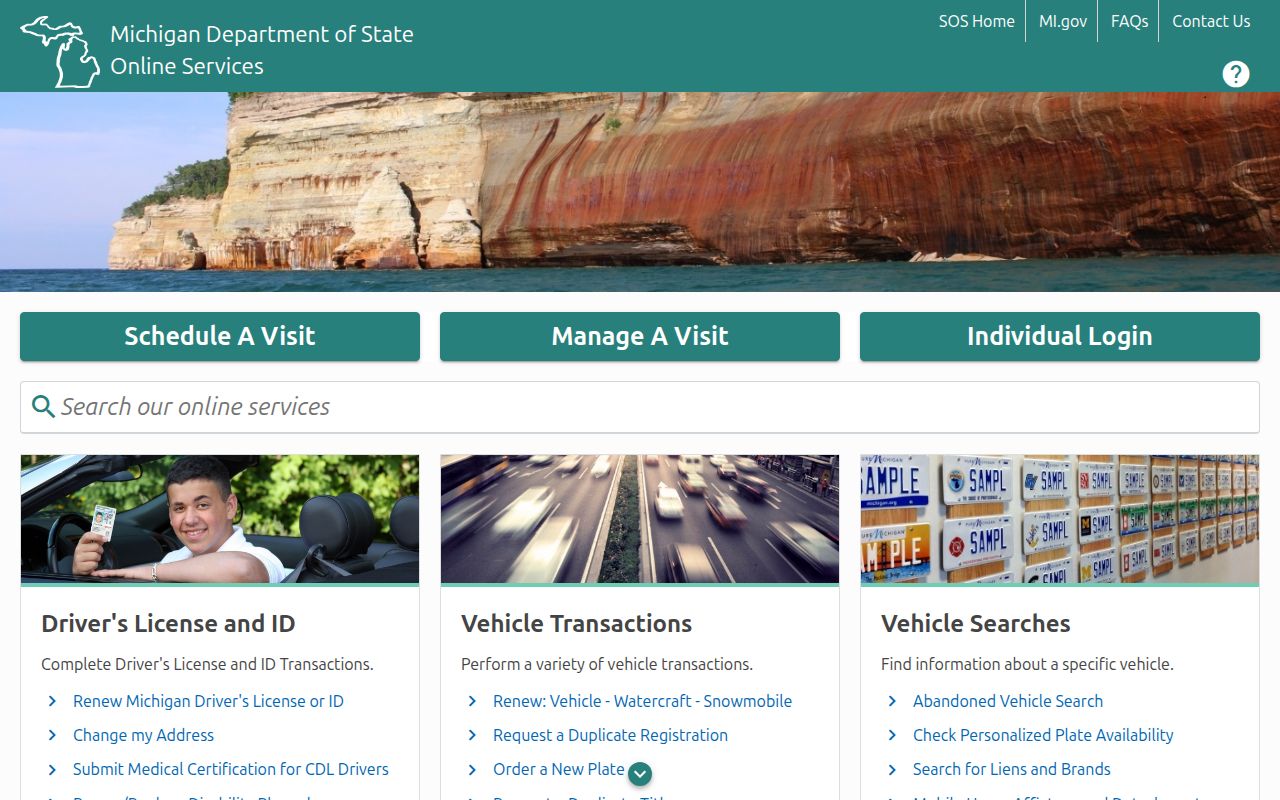
Authentication is one reason a driving-history request should never be confused with a public name search in a local traffic docket.
Michigan Court File vs Driving Record
The two Michigan files answer different questions. The court file proves what was cited, litigated, and decided. The SOS record shows the state’s current license view and reportable driving history. Corrections also start in different places. A wrong plea or judgment goes to the issuing court. A license-status or state posting problem goes to SOS, often after the court has supplied a corrected abstract.
| Feature | Court Traffic Record | SOS Driving Record |
|---|---|---|
| Custodian | District or Municipal Court | Michigan Department of State |
| Search key | File number or party | Authenticated identity or authorized request |
| Shows | Plea, hearing, disposition, costs, payment, FTA docket | Status, points, restrictions, suspensions, reportable history |
| Correction | Issuing court | SOS, often after a corrected court abstract |
| Fee | Inspection free; local copy or payment charges vary | $15 record plus $1 certification; office certified copy $16 |
Michigan CDL and OWI Cases
Commercial drivers face federal and state reporting consequences. A CDL holder should not assume that a local mitigation choice will keep a qualifying conviction from the driver record. The effect can depend on the offense, the vehicle, and the holder’s status. The court resolves the charge, while SOS applies license rules. That split makes it wise to verify both files after a judgment.
Michigan calls impaired driving OWI. It follows criminal procedure, even when it began with a roadside traffic stop. The District Court file can include arraignment, bond, pleas, motions, sentence, and later compliance events. For the arrest-to-charge path and criminal status terms, consult Michigan arrest and court charge records. A driver record will not show each criminal docket event.
Note: A court dismissal and a state licensing action can have different legal effects and different correction routes.
Michigan Improvement and Set-Asides
Eligible Michigan drivers may receive notice for the Basic Driver Improvement Course. Passing within the stated 60-day eligibility period can keep qualifying ticket information from insurance disclosure. It does not erase the court case. Eligibility comes through the state process, so a driver should rely on the notice and SOS instructions rather than assume any ticket qualifies.
Michigan uses “setting aside” for expungement relief. Eligibility depends on the offense and statute. A dismissed traffic count is not the same as a set-aside conviction, and relief cannot be promised from a docket screen. Set-aside information becomes nonpublic for most purposes but is not physically erased from every government system. Start with official Clean Slate materials and the court of conviction. The SOS record may require a separate review after the court acts.
Michigan Traffic Access and Fees
MCR 8.119 governs access to Michigan court case records. Inspection and retrieval of a public case record cannot be charged, though actual reproduction, certification, postage, or archive work may carry an authorized local cost. Court case requests go to the clerk under court rules. Michigan FOIA is the route for existing releasable executive or local agency records, not a substitute demand for a judicial case file.
The driver record has its own fixed state charge. Court ticket amounts and payment service charges are case-specific. Ask the clerk for the balance and copy quote before sending money. Protected identifiers, sealed matters, and nonpublic information remain unavailable through the public case screen.
| Item | Michigan Fee Rule |
|---|---|
| Inspect or retrieve public court record | No fee under MCR 8.119(J)(1) |
| Court copy or certification | Actual reproduction and locally authorized charges vary |
| SOS driving record | $15 |
| Certification | $1 additional |
| SOS office certified own record | $16 |
Find Michigan Traffic Court Records
Use the directory of all 83 Michigan counties when MiCOURT does not show the case, when a document image is missing, or when the local payment and hearing channels must be confirmed. Choose the county where the citation was issued, then contact the District Court or one of the four Municipal Courts printed on the ticket. Ask for the official file, a plain or certified copy, or the correct balance. Use SOS separately for license status and driving history.