
Michigan Inmate Records Systems
County jail and state corrections records answer different questions. Michigan sheriffs operate county jails for people awaiting arraignment or trial, those who have not posted bond, people serving shorter local sentences, and sentenced defendants waiting for state transfer. There is no single official statewide county-jail roster. Each sheriff chooses its public access channels, which may include an online roster, vendor, booking line, front desk, officially linked app, VINE notification, or a FOIA request for releasable booking documents.
The Michigan Department of Corrections runs prisons and supervises probationers and parolees. After a state prison sentence and classification or transfer, search OTIS rather than a county roster. A person may disappear from the county search before appearing at a permanent MDOC location, so confirm transfer status with the jail. Federal prisoners belong in the Federal Bureau of Prisons Inmate Locator. Immigration and out-of-state custody also use their own agencies.
Michigan OTIS Inmate Locator
The Michigan Department of Corrections Offender Tracking Information System, known as OTIS, is the central state-level inmate and supervision search. It covers prisoners, parolees, and probationers currently under MDOC supervision, plus offenders discharged within three years of supervision discharge. It excludes people held only in a county jail and is not a full criminal-history report. The MDOC number is unique and is the best search key when known.
OTIS accepts last and first name, MDOC number, sex, age with a plus-or-minus range, race, status, and scars, marks, or tattoos. Name wildcard and minimum-character rules apply. Mark and tattoo searches use exact text, and special characters are not recognized. Profiles may show aliases, physical descriptors, photo, current prison or supervision office, offenses, sentencing county and court, minimum and maximum terms, release or parole information, and absconder status. Safety, statutory, and operational limits can withhold some data.
MDOC updates OTIS from correctional and sentencing information, including changes required by set-aside law or sentencing-court direction. Even a deceased or discharged offender may remain during the stated three-year post-discharge display period. A listed minimum date is not a promise of release, and an institution name may change through classification or transfer. For a legal question about the conviction, use the sentencing court. For current housing or supervision, use MDOC.
The Michigan Department of Corrections' official OTIS information explains the public locator and its state-custody scope.
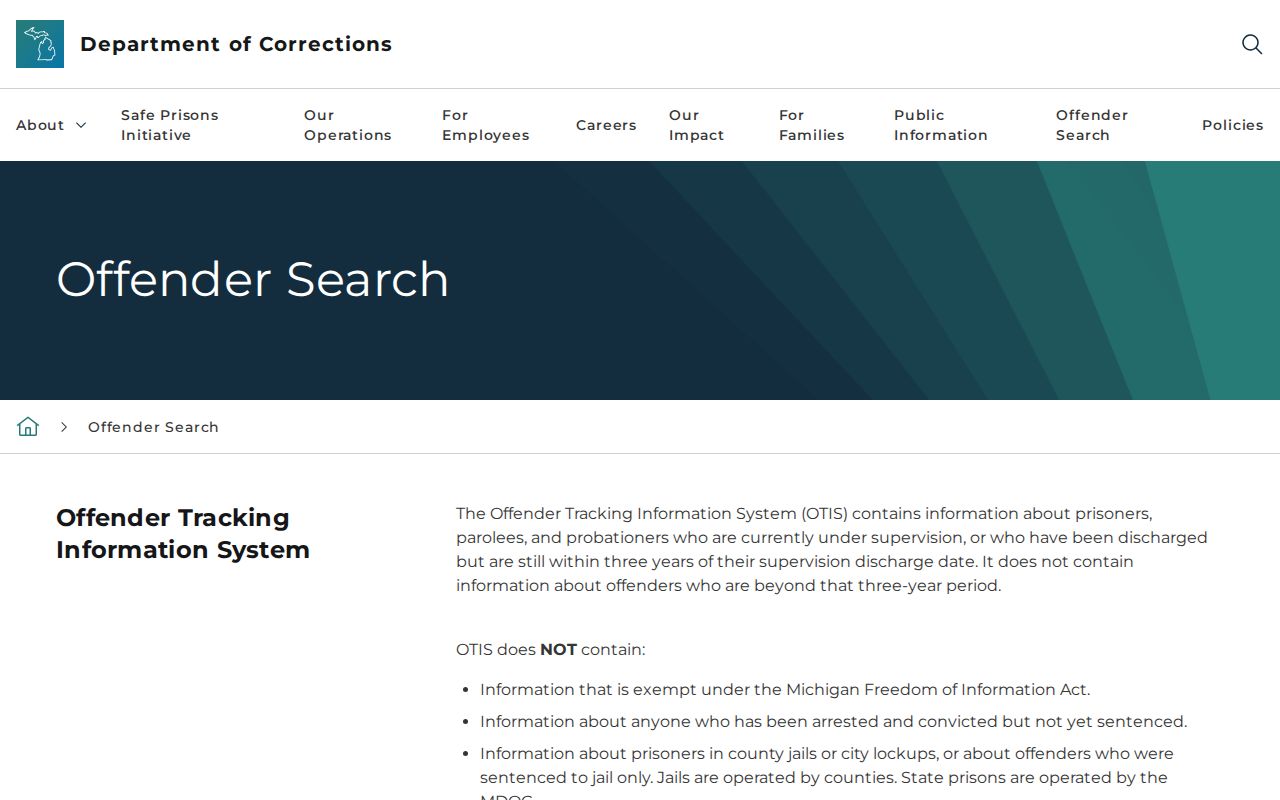
The state resource is the right starting point for MDOC custody and supervision, but county-only bookings remain outside OTIS.
- Open OTIS and search by the exact MDOC number when available.
- For a name search, enter the last name and add first name, age, race, sex, or status to narrow the result.
- Compare aliases, physical details, and sentencing county before selecting a profile.
- Open the matching profile and read location, supervision status, offenses, sentence terms, and release information.
- Use the named facility or supervision office's official contact route to confirm current placement and communication rules.
| Field | What It Shows |
|---|---|
| MDOC number | Unique Michigan corrections identifier and the most precise OTIS search key. |
| Status and location | Prison, parole, probation, absconder, discharge status, or supervision office when displayed. |
| Offenses | Convictions connected with MDOC supervision, including sentencing county and court details. |
| Sentence terms | Minimum and maximum terms and key sentence dates reported to MDOC. |
| Release information | Parole-board or release data when public; it is not a guarantee of release on a fixed date. |
| Identity details | Aliases, sex, race, age or birth information, physical traits, marks, and photograph when available. |
County jail vs. state prison: If OTIS has no match, search the arrest county's official jail channels. County-only detainees never appear in OTIS merely because they are incarcerated.
Michigan County Jail Records
Michigan's 83 counties maintain local custody through their sheriffs. Not every sheriff publishes an online roster. Some offer a 24-hour booking line or front-desk confirmation, while others use a vendor search. MI-VINE can provide status notifications for qualifying events, but it is a notification service rather than the official inmate file. A written FOIA request may obtain an existing releasable booking record, subject to law and agency procedure.
The representative county research found no official public Mason online jail roster and documented phone, in-person, and FOIA fallbacks instead. That local result must not be generalized to every county, but it proves why the Michigan county directory and official sheriff contacts are essential. Never substitute a commercial people-search database for the actual custodian.
Find an Inmate in Michigan
Use the event timeline to choose a system. A recent arrest, pending case, local sentence, or wait for transfer points to a county jail. A completed state-prison sentence, parole, or MDOC probation points to OTIS. Search both when transfer or release timing is uncertain.
- For a recent arrest, select the arrest county and open its official sheriff or jail information.
- Use the online roster if the sheriff links one. Otherwise call the jail or use its records-request procedure.
- For state custody or supervision, search OTIS by MDOC number or name and identifiers.
- Check MI-VINE when custody-event notification is needed, while treating the jail or MDOC as the official source.
- Confirm the present location before sending mail, funds, or a visitation request because transfers can occur.
Michigan Jail Search Fields
County roster fields vary, and a sheriff may offer no public web form. When a search exists, the common inputs below are useful. Use the fewest fields needed at first, then narrow a common name with booking or identity details.
| Field Label | Type | Required | Notes |
|---|---|---|---|
| Last name | Text | Usually | Spelling and wildcard behavior depend on the county system. |
| First name | Text | Varies | Narrows a common surname. |
| Booking number | Text | No | Use the exact county booking identifier when known. |
| Date of birth or age | Date or number | No | Helps distinguish people with similar names if the roster permits it. |
| Booking date or status | Date or filter | No | Can separate current custody from older releases. |
Michigan Jail Profile Fields
A public county profile is a current booking summary, not a conviction report. Charges are allegations until adjudicated. Release dates and housing can change, and some fields may be suppressed for safety or privacy. Confirm a result with the jail before acting on it.
| Field | What It Shows |
|---|---|
| Name and booking number | Identifies the local custody episode and subject. |
| Booking date and agency | Shows intake timing and the arresting or committing body. |
| Charges and court | Lists allegations and may connect them to a court or case number. |
| Bond type and amount | Shows public release terms when set; confirm current terms with the court or jail. |
| Facility or housing | Identifies current jail placement when the county releases it. |
| Release status | May show custody, transfer, release, or a projected event subject to change. |
Michigan County Jail Facilities
Facility addresses, booking numbers, approved communication vendors, mail formats, deposit methods, and visit schedules are local. A larger Michigan county may use more than one building, and a person can be moved without a court-docket update. The county sheriff's official page controls practical jail rules. Use the county directory, then verify the facility shown on the current inmate profile.
A representative jail's facility information illustrates the level of local detail that can differ across Michigan.
The representative source is not a statewide schedule or roster. It reinforces that users must consult the county actually holding the inmate.
Michigan Jail Booking Process
Booking starts when law enforcement delivers an arrestee to a county jail. Staff confirm identity, inventory property, take fingerprints and a photograph, enter charges, screen medical needs, and classify housing. Public roster timing depends on county practice and safety review. An immediate name search can therefore miss a person still in intake. Call the booking desk if an official roster has not yet updated.
After intake, the person proceeds to an initial appearance or arraignment as the case requires. Bond may be personal recognizance, cash, ten-percent where authorized, or surety. Serious cases can involve detention or no release under applicable law. The jail displays custody data, while the court controls the criminal case, bond order, and hearing record. A booking entry should not be read as proof of guilt.
Michigan Inmate Visitation Rules
Michigan county sheriffs set their own visitor approval, identification, dress, check-in, in-person, and video rules. The research documented the representative schedule below for one county. It must not be used for another jail. Confirm current times through the county directory because housing, staffing, discipline, emergencies, and vendor changes can alter visits without changing a court record.
| Day | Hours | Type |
|---|---|---|
| Saturday | 8:30 a.m. to 11:00 a.m. | Representative female-inmate group |
| Saturday | 1:00 p.m. to 4:30 p.m. | Representative A-G male-inmate group |
| Sunday | 8:30 a.m. to 11:00 a.m. | Representative H-Z female-inmate group as published |
| Sunday | 1:00 p.m. to 4:30 p.m. | Representative A-G male-inmate group as published |
The same representative source says visitors must be approved and on the inmate's list, should arrive 25 minutes early, and receive a 20-minute visit. Video visits use a named vendor. Those facts describe the inspected county only. MDOC prison visits instead use state facility pages and MDOC visiting applications and rules.
Contact Michigan Inmates
Confirm the current facility before using mail, phone, or video. Each county jail selects its own vendor and can limit mail size, paper, enclosures, sender details, photographs, publications, and deposit methods. Use the exact address format published by that jail, including inmate name and booking number. Mail sent to an old facility may be delayed or rejected. Calls can be outgoing only and may be monitored or recorded.
MDOC prison contact works differently. Open the OTIS profile, identify the prison or supervision office, and then use that facility's official MDOC page. Follow the state visiting application and mail rules rather than county instructions. MI-VINE may notify a registered user of a qualifying release, transfer, or escape event, but it does not carry messages to an inmate.
For either system, keep the inmate identifier with the name. County booking numbers can change with a new custody episode, while the MDOC number is the stable state corrections identifier. Do not place cash, personal checks, prohibited enclosures, or sensitive account data in mail unless the official facility instructions expressly permit that method. Returned mail and rejected deposits can take time to correct after a transfer.
Michigan Inmate Funds and Records
County jails administer trust or commissary accounts under local policy, often through a contracted service, kiosk, mail method, or approved visitor procedure. Limits, accepted cards or money orders, fees, refund rules, and the details needed to credit an account vary. Confirm the current vendor on the official jail site and match the inmate's booking number before paying. A commercial payment screen is not an inmate locator.
The representative county research described commissary purchases, a lobby kiosk, and deposits tied to local visiting or mail rules. Those methods cannot be projected across Michigan. State-prison deposits follow MDOC's current approved channels. Do not send money based on a stale profile or third-party instruction. Verify custody and recipient identifiers first.
Michigan corrections also maintains Crime Victim Services at 877-886-5401 and 517-373-4467, while the Parole Board public contact is 517-373-0270. Those state contacts address their assigned functions, not county booking searches.
Note: Always verify current custody before mailing funds because a county release, jail transfer, or move into MDOC custody changes the proper account system.